what famous gershwin work has by some, been upgraded to the status of opera, rather than musical?
| Rhapsody in Blueish | |
|---|---|
| by George Gershwin | |
 Cover of the original canvas music of Rhapsody in Blue | |
| Genre | Orchestral jazz |
| Form | Rhapsody |
| Composed | Jan 1924 (1924-01) |
| Published | June 12, 1924 (1924-06-12) Harms, Inc.[1] |
| Premiere | |
| Date | February 12, 1924 (1924-02-12) |
| Location | Aeolian Hall, New York City, Usa |
| Conductor | Paul Whiteman |
| Performers | George Gershwin (piano) Ross Gorman (clarinet) |
| Recordings | |
| The U.s.a. Marine Band'due south 2018 functioning of the 1924 jazz band version, with pianist Bramwell Tovey
| |
Rhapsody in Blueish is a 1924 musical limerick written by George Gershwin for solo piano and jazz ring, which combines elements of classical music with jazz-influenced effects. Commissioned past bandleader Paul Whiteman, the work premiered in a concert titled "An Experiment in Mod Music" on Feb 12, 1924, in Aeolian Hall, New York Urban center.[2] [3] Whiteman's band performed the rhapsody with Gershwin playing the piano.[4] Whiteman'south arranger Ferde Grofé orchestrated the rhapsody several times including the 1924 original scoring, the 1926 pit orchestra scoring, and the 1942 symphonic scoring.
The rhapsody is i of Gershwin's nigh recognizable creations and a central composition that defined the Jazz Age.[five] [half dozen] [vii] Gershwin'south piece inaugurated a new era in America's musical history,[8] established Gershwin'due south reputation every bit an eminent composer, and eventually became i of the near popular of all concert works.[9] The American Heritage mag posits that the famous opening clarinet glissando has become equally instantly recognizable to concert audiences as the opening of Beethoven'due south Fifth Symphony.[10]
History [edit]
Commission [edit]


Following the success of an experimental classical-jazz concert held with Canadian singer Éva Gauthier in New York City on November one, 1923, bandleader Paul Whiteman decided to attempt a more ambitious feat.[ii] He asked composer George Gershwin to write a concerto-like slice for an all-jazz concert in honor of Lincoln'southward Birthday to be given at Aeolian Hall.[11] Whiteman became fixated upon performing such an extended composition past Gershwin later he collaborated with him in The Scandals of 1922.[12] He had been especially impressed by Gershwin'due south one-act "jazz opera" Bluish Monday.[13] Gershwin initially declined Whiteman's request on the grounds that—as there would likely exist a need for revisions to the score—he would accept insufficient time to compose the work.[14]
Before long after, on the evening of January iii, George Gershwin and lyricist Buddy DeSylva were playing billiards at the Ambassador Billiard Parlor at Broadway and 52nd Street in Manhattan.[fifteen] Their game was interrupted past Ira Gershwin, George's blood brother, who had been reading the January iv edition of the New-York Tribune.[16] An unsigned article entitled "What Is American Music?" about an upcoming Whiteman concert had defenseless Ira's attention.[xv] The commodity falsely declared that George Gershwin was already "at work on a jazz concerto" for Whiteman's concert.[17]
Gershwin was puzzled past the news annunciation equally he had politely declined to compose any such work for Whiteman.[18] [nineteen] In a telephone conversation with Whiteman the adjacent morning time, Gershwin was informed that Whiteman'south curvation rival Vincent Lopez was planning to steal the idea of his experimental concert and there was no time to lose.[20] Gershwin was thus finally persuaded past Whiteman to etch the slice.[20]
Composition [edit]
With simply five weeks remaining until the premiere, Gershwin hurriedly set almost composing the work.[xv] He later claimed that, while on a railroad train journey to Boston, the thematic seeds for Rhapsody in Blue began to germinate in his mind.[21] [20] He told biographer Isaac Goldberg in 1931:
It was on the train, with its steely rhythms, its rattle-ty blindside, that is so ofttimes so stimulating to a composer.... I ofttimes hear music in the very heart of the noise. And in that location I of a sudden heard—and even saw on paper—the complete construction of the rhapsody, from showtime to end. No new themes came to me, only I worked on the thematic material already in my mind and tried to conceive the composition as a whole. I heard it as a sort of musical kaleidoscope of America, of our vast melting pot, of our unduplicated national pep, of our metropolitan madness. By the time I reached Boston I had a definite plot of the piece, every bit distinguished from its bodily substance.[21]
Gershwin began composing on January vii as dated on the original manuscript for two pianos.[2] He tentatively entitled the slice as American Rhapsody during its composition.[22] The revised title Rhapsody in Blueish was suggested by Ira Gershwin after his visit to a gallery exhibition of James McNeill Whistler paintings, which had titles such as Nocturne in Black and Gold: The Falling Rocket and Arrangement in Grey and Blackness.[22] [23] Later a few weeks, Gershwin finished his limerick and passed the score to Ferde Grofé, Whiteman's arranger.[24] Grofé finished orchestrating the slice on February 4—a mere 8 days before the premiere.[24]
Premiere [edit]
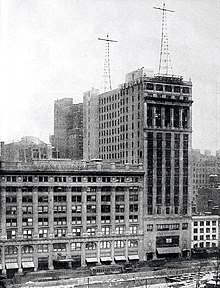
Rhapsody in Blue premiered during a snowy afternoon on Tuesday, Feb 12, 1924, at Aeolian Hall, Manhattan.[4] [25] Entitled "An Experiment in Modern Music,"[3] the much-anticipated concert held by Paul Whiteman and his Palais Royal Orchestra drew a "packed audience."[iv] [26] The excited audition consisted of "vaudevillians, concert managers come to have a look at the novelty, Tin Pan Alleyites, composers, symphony and opera stars, flappers, block-eaters, all mixed up higgledy-piggledy."[25] Many influential figures of the era were present, including Carl Van Vechten,[eight] Marguerite d'Alvarez,[8] Victor Herbert,[27] Walter Damrosch,[27] Igor Stravinsky,[28] Fritz Kreisler,[28] Leopold Stokowski,[28] John Philip Sousa,[29] and Willie "the Lion" Smith.[29]
In a pre-concert lecture, Whiteman'southward manager Hugh C. Ernst proclaimed the purpose of the concert was "to be purely educational".[30] [31] The selected music was intended to exemplify the "melodies, harmony and rhythms which agitate the throbbing emotional resources of this young restless age."[32] The concert'south program was lengthy with 26 dissever musical movements, divided into 2 parts and 11 sections, bearing titles such as "True Class Of Jazz" and "Dissimilarity—Legitimate Scoring vs. Jazzing."[33] In the program's schedule, Gershwin's rhapsody was merely the penultimate piece and preceded Elgar's Pomp and Circumstance March No. ane.[34]
Many of the early on numbers in the program reportedly underwhelmed the audience, and the ventilation arrangement in the concert hall malfunctioned.[35] Some audience members were parting for the exits by the time Gershwin fabricated his camouflaged entrance for the rhapsody.[35] The audition purportedly were irritable, impatient, and restless until the haunting clarinet glissando that opened Rhapsody in Blue was heard.[three] [36] The distinctive glissando had been created quite past happenstance during rehearsals:
As a joke on Gershwin.... [Ross] Gorman [Whiteman's virtuoso clarinetist] played the opening measure with a noticeable glissando, 'stretching' the notes out and adding what he considered a jazzy, humorous touch to the passage. Reacting favorably to Gorman's whimsy, Gershwin asked him to perform the opening measure that way.... and to add equally much of a 'wail' as possible.[37]
The rhapsody was and then performed past Whiteman's orchestra consisting of "twenty-iii musicians in the ensemble" with George Gershwin on pianoforte.[38] [39] In feature way, Gershwin chose to partially improvise his piano solo.[39] The orchestra anxiously waited for Gershwin's nod which signaled the end of his pianoforte solo and the cue for the ensemble to resume playing.[39] As Gershwin improvised some of what he was playing, the solo piano section was not technically written until after the performance, and it remains unknown exactly how the original rhapsody sounded at the premiere.[xl]
Audience reaction and success [edit]
Upon the determination of the rhapsody, there was "tumultuous applause for Gershwin's composition,"[four] [41] and, quite unexpectedly, "the concert, in every respect but the financial,[a] was a 'knockout'."[43] The concert quickly became historically significant due to the premiere of the rhapsody, and its programme would "get not only a historic document, finding its way into strange monographs on jazz, just a rarity as well."[25]
Following the success of rhapsody'south premiere, future performances followed. The first British operation of Rhapsody in Blue took place at the Savoy Hotel in London on June 15, 1925.[44] It was circulate in a live relay past the BBC. Debroy Somers conducted the Savoy Orpheans with Gershwin himself at the piano.[44] The piece was heard once again in the United Kingdom during the 2d European tour of the Paul Whiteman Orchestra, well-nigh notably on April 11, 1926, at the Royal Albert Hall, with Gershwin in the audience. The Regal Albert Hall concert was recorded—though not issued—past the Gramophone Visitor/HMV.[45] [46]
By the end of 1927, Whiteman's band had performed Rhapsody in Blueish approximately 84 times, and its recording sold a million copies.[10] For the entire piece to fit onto two sides of a 12-inch tape, the rhapsody had to be played at a faster speed than usual in a concert, which gave it a hurried feel and some rubato was lost. Whiteman subsequently adopted the piece as his ring's theme song and opened his radio programs with the slogan "Everything new but the Rhapsody in Bluish."[47]
Critical response [edit]
Contemporary reviews [edit]
"Jazz is basically a kind of rhythm plus a kind of instrumentation. But it seems to u.s. that this kind of music is only half alive. Its gorgeous vitality of rhythm and of instrumental colour is dumb by melodic and harmonic anemia of the most pernicious kind.... [I] recall the virtually aggressive slice [of Whiteman's concert], the Rhapsody, and weep over the lifelessness of its melody and harmony, so derivative, then stale, then inexpressive."
— Lawrence Gilman, New-York Tribune, February 1924[48]
In contrast to the warm reception past concert audiences,[4] [43] professional music critics in the printing gave the rhapsody decidedly mixed reviews.[49] Pitts Sanborn declared that the rhapsody "begins with a promising theme well stated" yet "soon runs off into empty passage-work and meaningless repetition."[41] A number of reviews were particularly negative. I opinionated music critic, Lawrence Gilman—a Richard Wagner enthusiast who would later write a devastating review of Gershwin's Porgy and Bess—harshly criticized the rhapsody as "derivative," "dried," and "inexpressive" in New-York Tribune review on February 13, 1924.[50] [48]
Other reviewers were more positive. Samuel Chotzinoff, music critic of the New York World, conceded that Gershwin'south composition had "made an honest woman out of jazz,"[27] while Henrietta Strauss of The Nation opined that Gershwin had "added a new chapter to our musical history."[8] Olin Downes, reviewing the concert in The New York Times, wrote:
This composition shows extraordinary talent, as it shows a young composer with aims that go far beyond those of his ilk, struggling with a grade of which he is far from being principal.... In spite of all this, he has expressed himself in a significant and, on the whole, highly original grade.... His kickoff theme... is no mere dance-tune... it is an thought, or several ideas, correlated and combined in varying and contrasting rhythms that immediately intrigue the listener. The 2d theme is more later the way of some of Mr. Gershwin'due south colleagues. Tuttis are too long, cadenzas are too long, the peroration at the terminate loses a big measure of the wildness and magnificence it could hands have had if information technology were more broadly prepared, and, for all that, the audience was stirred and many a hardened concertgoer excited with the sensation of a new talent finding its voice.[4]
Overall, a recurrent criticism leveled by professional music critics was that Gershwin'southward piece was substantially formless and that he had haphazardly glued melodic segments together.[51]
Retrospective reviews [edit]
Years after its premiere, Rhapsody in Blue connected to carve up music critics principally due to its perceived melodic incoherence.[52] [53] [54] Abiding Lambert, a British conductor, was openly dismissive towards the work:
The composer [George Gershwin], trying to write a Lisztian concerto in a jazz style, has used but the non-barbarian elements in dance music, the result being neither good jazz nor good Liszt, and in no sense of the word a good concerto.[52]
In an article in The Atlantic Monthly in 1955, Leonard Bernstein, who nevertheless admitted that he adored the piece,[53] stated:
Rhapsody in Blue is not a existent composition in the sense that whatsoever happens in it must seem inevitable, or fifty-fifty pretty inevitable. You can cut out parts of it without affecting the whole in any way except to brand it shorter. You tin can remove any of these stuck-together sections and the piece still goes on as bravely as before. Y'all tin even interchange these sections with one some other and no harm washed. Yous can make cuts within a section, or add new cadenzas, or play information technology with any combination of instruments or on the piano lonely; it tin be a five-minute piece or a six-infinitesimal piece or a twelve-minute piece. And in fact all these things are being washed to information technology every day. It's nevertheless the Rhapsody in Bluish.[53] [54]
Orchestration [edit]

Ferde Grofé, Whiteman's chief arranger from 1920 to 1932, created the beginning arrangement of Gershwin's Rhapsody in Blue.
Every bit Gershwin did non take sufficient knowledge of orchestration in 1924,[55] Ferde Grofé—Whiteman's pianist and main arranger—was a key figure in enabling the rhapsody's meteoric success,[56] and critics take contended that Grofé's arrangements of the Rhapsody secured its identify in American civilization.[57] Gershwin'south biographer, Isaac Goldberg, noted in 1931 that Grofé played a crucial role in the premiere'southward triumph:
In the estrus of the occasion, the contribution of Ferdie [sic] Grofé, the arranger on the Whiteman staff who had scored the Rhapsody in ten days, was overlooked or ignored. It is true that an appreciable function of the scoring had been indicated by Gershwin; however, the contribution of Grofé was of prime number importance, not only to the limerick, merely to the jazz scoring of the immediate future.[56]
Grofé's familiarity with the Whiteman band's strengths was a fundamental gene in his 1924 scoring.[58] This orchestration was developed for solo piano and Whiteman's twenty-three musicians.[59] For the reeds section, Ross Gorman (Reed I) played an oboe, a heckelphone, a clarinet in B ♭ , sopranino saxophones in E ♭ & B ♭ , an alto saxophone, 1 Due east ♭ soprano clarinet, and alto and bass clarinets; Donald Clark (Reed II) played a soprano saxophone in B ♭ , alto and baritone saxophones, and Unhurt Byers (Reed Iii) played soprano saxophone in B ♭ , tenor saxophone, baritone saxophone, and a flute.[59]
For the brass section, 2 trumpets in B ♭ were played by Henry Busse and Frank Siegrist; two French horns in F played past Arturo Cerino and Al Corrado; two trombones played by Roy Maxon and James Casseday, and a tuba and a double bass played by Guss Helleburg and Albert Armer respectively.[59] [threescore] [61] [43]
The percussion section included a pulsate fix, timpani, and a glockenspiel played by George Marsh; one piano typically played by either Ferde Grofé or Henry Lange; i tenor banjo played by Michael Pingatore, and a complement of violins.[62]
This original arrangement—with its unique instrumental requirements—was largely ignored until its revival in reconstructions beginning in the mid-1980s, attributable to the popularity and serviceability of the later scorings.[63] Afterward the 1924 premiere, Grofé revised the score and made new orchestrations in 1926 and 1942, each time for larger orchestras.[63] His arrangement for a theater orchestra was published in 1926.[64] This adaptation was orchestrated for a more standard "pit orchestra," which included i flute, i oboe, two clarinets, one bassoon, three saxophones; ii French horns, 2 trumpets, and two trombones; as well equally the same percussion and strings complement as the later 1942 version.[65]
Paul Whiteman once more performed Rhapsody in Blue in the film King of Jazz (1930), arranged by Grofé.
The later 1942 organization by Grofé was for a total symphony orchestra. Information technology is scored for solo pianoforte and an orchestra consisting of two flutes, two oboes, two clarinets in B ♭ and A, one bass clarinet, 2 bassoons, 2 alto saxophones in E ♭ , one tenor saxophone in B ♭ ; three French horns in F, three trumpets in B ♭ , three trombones, one tuba; a percussion section that includes timpani, i suspended cymbal, i snare drum, i bass drum, ane tam-tam, 1 triangle, one glockenspiel, and cymbals; one tenor banjo; and strings. Since the mid-20th century, this 1942 version was the arrangement usually performed by classical orchestras and became a staple of the concert repertoire until 1976 when Michael Tilson Thomas recorded the original jazz band version for the first fourth dimension, employing Gershwin's actual 1925 piano coil with a full jazz orchestra.[63]
Grofé'due south other arrangements of Gershwin's piece include those done for Whiteman'southward 1930 picture show, Rex of Jazz,[66] and the concert band setting (playable without pianoforte) completed by 1938 and published 1942. The prominence of the saxophones in the later orchestrations is somewhat reduced, and the banjo office can exist dispensed with, every bit its mainly rhythmic contribution is provided by the inner strings.[67]
Gershwin himself made versions of the piece for solo piano besides as two pianos.[68] The solo version is notable for omitting several sections of the piece.[b] Gershwin'southward intent to eventually do an orchestration of his ain is documented in 1936–37 correspondence from publisher Harms.[69]
Notable recordings [edit]

Late 1930s reissue of the 1927 electrical release of Rhapsody in Blue as Victor 35822A by Paul Whiteman and His Concert Orchestra with George Gershwin on pianoforte. 1974 Grammy Hall of Fame inductee.
Later on the warm reception of Rhapsody in Blue by the audition at Aeolian Hall, Gershwin recorded several abridged versions of his limerick in unlike formats.[70] On June 10, 1924, Gershwin and Whiteman's orchestra created an acoustic recording running 8 minutes and 59 seconds and produced by the Victor Talking Machine Company.[c] [72] A year later, Gershwin recorded his performance on a 1925 piano roll for a two-piano version.[73] Afterwards, on Apr 21, 1927, he made an electrical recording with Whiteman's orchestra running 9 minutes and 1 second and again produced by Victor.[d] [74] Nathaniel Shilkret purportedly conducted the electrical recording after a dispute betwixt Gershwin and Whiteman.[75] Whiteman's orchestra later performed a truncated version of the piece in the 1930 picture The King of Jazz with Roy Bargy on piano.[76]
Due to the length limitations of early on recording formats, information technology was not until the Great Depression that the first complete and unabridged recording of Gershwin's composition could be undertaken. In July 1935, after several years of performing the rhapsody for sold-out audiences in Massachusetts,[77] conductor Arthur Fiedler and the Boston Pops Orchestra recorded the get-go unabridged version—virtually fourteen minutes in length—with Puerto Rican pianist Jesús María Sanromá for RCA Victor.[e] [78] For this commencement entire recording, Fiedler discarded Ferde Grofé'southward original 1924 arrangement and adjusted the slice for a conventional symphony.[79] At the time, gimmicky critics praised Fiedler for jettisoning the and then-called "jazzy sentimentality" of Grofé's before system and adding a "more than symphonic richness and authority."[eighty]
During the final months of World State of war II, amid the box-office success of the Gershwin biographical film Rhapsody in Blue (1945), pianist Oscar Levant recorded the at present iconic limerick with Eugene Ormandy's Philadelphia Orchestra on August 21, 1945.[81] Levant had been an intimate friend of the deceased composer,[82] [83] and he sought to replicate Gershwin'southward idiomatic playing style in his operation.[84] Levant'due south homage—labelled Columbia Masterworks 251—received rapturous reviews and became one of the best-selling record albums of the year.[85] As a consequence of Levant'southward recording and the 1945 biographical film most Gershwin's life, an ensuing "Gershwin revival" occurred.
By the 1960s and 1970s, Gershwin's rhapsody had become a predictable staple of both concert performances and orchestra recordings; consequently, more diverse and irreverent interpretations appeared over time. In Summer 1973, Brazilian jazz-stone artist Eumir Deodato reinterpreted Gershwin'southward rhapsody in an abridged version that featured uptempo neo‐samba rhythms.[86] Although music critics derided Deodato's interpretation as "mangled" and barely recognizable,[87] his unmarried reached No. 45 on the "Hot 100" and No. x on "Easy Listening" of the Billboard charts.[88] In the wake of Deodato's earlier reinterpretation, French pianist Richard Clayderman recorded a similarly abridged disco arrangement in 1978 which became ane of his signature pieces.[89] [ninety]
Concurrent with the emergence of these more diverse interpretations, scholarly interest revived in the original 1924 organization past Ferde Grofé which had not been performed since the stop of the Jazz Age. On February 14, 1973, conductor Kenneth Kiesler and pianist Paul Verrette performed Grofé'due south original arrangement on the University of New Hampshire campus.[91] Presently after, usher Michael Tilson Thomas and the Columbia Jazz Band recorded Grofé's arrangement in 1976, as did usher Maurice Peress with pianist Ivan Davis in 1984 as part of a 60th-anniversary reconstruction of the entire 1924 concert.[92]
Nearly a hundred years later the debut of Gershwin's rhapsody in 1924, tens of thousands of orchestras likewise every bit solo pianists accept recorded the enduring composition, both abridged and unabridged, to the please of audiences. A number of these recordings have garnered critical recognition such as pianist Michel Camilo's 2006 rendition which won a Latin Grammy Award.[93]
Class and analysis [edit]

The opening bars of Gershwin's score for the rhapsody, often referred to as the "Glissando theme".
As a jazz concerto, Rhapsody in Blue is written for solo piano with orchestra.[94] A rhapsody differs from a concerto in that it features ane extended motility instead of separate movements. Rhapsodies frequently contain passages of an improvisatory nature—although written out in a score—and are irregular in class, with heightened contrasts and emotional exuberance. The music ranges from intensely rhythmic piano solos to slow, broad, and richly orchestrated sections. Consequently, the Rhapsody "may be looked upon as a fantasia, with no strict fidelity to grade."[95]
The opening of Rhapsody in Bluish is written as a clarinet trill followed past a legato, 17 notes in a diatonic scale. During a rehearsal, Whiteman'south virtuoso clarinetist, Ross Gorman, rendered the upper portion of the calibration equally a captivating and trombone-like glissando.[96] Gershwin heard it and insisted that it be repeated in the performance.[96] The effect is produced using the tongue and throat muscles to modify the resonance of the oral cavity, thus decision-making the continuously rising pitch.[97] Many clarinet players gradually open the left-hand tone holes on their instrument during the passage from the last concert F to the superlative concert B ♭ as well. This effect has now become standard performance exercise for the piece of work.[97]
Rhapsody in Blue features both rhythmic invention and melodic inspiration, and demonstrates Gershwin's ability to write a piece with big-scale harmonic and melodic construction. The slice is characterized by stiff motivic inter-relatedness.[98] Much of the motivic material is introduced in the get-go fourteen measures.[98] Musicologist David Schiff has identified five major themes plus a sixth "tag".[22] Two themes appear in the first 14 measures, and the tag shows upwards in measure xix.[22] 2 of the remaining three themes are rhythmically related to the very first theme in measure out 2, which is sometimes called the "Glissando theme"—after the opening glissando in the clarinet solo—or the "Ritornello theme".[22] [99] The remaining theme is the "Train theme",[22] [100] which is the offset to appear at rehearsal 9 later the opening material.[100] All of these themes rely on the blues calibration,[101] which includes lowered sevenths and a mixture of major and minor thirds.[101] Each theme appears both in orchestrated form and as a piano solo. In that location are considerable differences in the style of presentation of each theme.
The harmonic construction of the rhapsody is more difficult to clarify.[102] The piece begins and ends in B ♭ major, but information technology modulates towards the sub-dominant direction very early on, returning to B ♭ major at the terminate, rather abruptly.[103] The opening modulates "downward", as it were, through the keys B ♭ , E ♭ , A ♭ , D ♭ , 1000 ♭ , B, E, and finally to A major.[103] Modulation through the circle of fifths in the reverse management inverts classical tonal relationships, just does non abandon them. The entire middle section resides primarily in C major, with forays into G major (the dominant relation).[104] Such modulations occur freely, although not always with harmonic direction. Gershwin frequently uses a recursive harmonic progression of minor thirds to give the illusion of move when in fact a passage does non change key from kickoff to end.[102] Modulation past thirds is a mutual feature of Tin Pan Aisle music.
The influences of jazz and other gimmicky styles are present in Rhapsody in Blue. Ragtime rhythms are abundant,[101] as is the Cuban "clave" rhythm, which doubles as a dance rhythm in the Charleston jazz dance.[49] Gershwin's own intentions were to correct the belief that jazz had to be played strictly in fourth dimension then that one could dance to it.[105] The rhapsody'south tempos vary widely, and at that place is an nearly extreme apply of rubato in many places throughout. The clearest influence of jazz is the employ of bluish notes, and the exploration of their half-footstep relationship plays a key part in the rhapsody.[106] The use of so-called "vernacular" instruments, such equally accordion, banjo, and saxophones in the orchestra, contribute to its jazz or popular way, and the latter two of these instruments have remained part of Grofé's "standard" orchestra scoring.[67]
Gershwin incorporated several different pianoforte styles into his piece of work. He used the techniques of footstep piano, novelty pianoforte, comic piano, and the song-plugger piano style. Pace piano'south rhythmic and improvisational style is axiomatic in the "agitato due east misterioso" department, which begins four bars later rehearsal 33, as well every bit in other sections, many of which include the orchestra.[100] Novelty piano tin can exist heard at rehearsal 9 with the revelation of the Train theme. The hesitations and calorie-free-hearted manner of comic pianoforte, a vaudeville approach to piano made well known by Chico Marx and Jimmy Durante, are axiomatic at rehearsal 22.[107]
Legacy and influence [edit]
Cultural zeitgeist [edit]
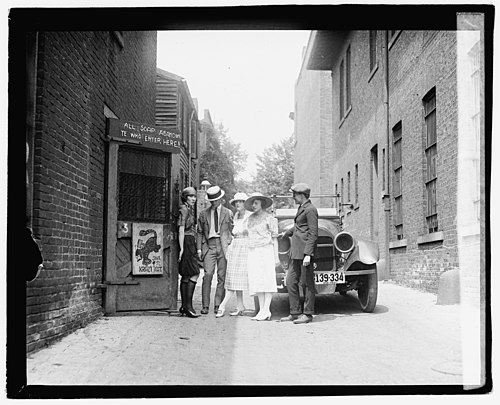
Gerswhin'southward work has been cited by writers and scholars equally embodying the Jazz Age'south zeitgeist with its flappers and speakeasies. Higher up: Patrons and a flapper await the opening of a speakeasy in 1921.
According to critic Orrin Howard of the Los Angeles Philharmonic, Gershwin'due south rhapsody "fabricated an indelible mark on the history of American music, on the fraternity of serious composers and performers—many of whom were present at the premiere—and on Gershwin himself, for its enthusiastic reception encouraged him to other and more serious projects."[vii]
Howard posits that the piece of work'south legacy is best understood as embodying the cultural zeitgeist of the Jazz Age:
Beginning with that incomparable, flamboyant clarinet solo, Rhapsody is irresistible however, with its syncopated rhythmic vibrancy, its abandoned, impudent flair that tells more about the Roaring Twenties than could a thousand words, and its genuine melodic beauty colored a deep, jazzy blue by the flatted sevenths and thirds that had their origins in the African-American slave songs.[7]
Although Gershwin'due south rhapsody "was by no means a definitive example of jazz in the Jazz Age,"[108] music historians such as James Ciment and Floyd Levin have similarly concurred that it is the primal composition that encapsulates the spirit of the era.[5] [109]
Equally early as 1927, author F. Scott Fitzgerald opined that Rhapsody in Blueish idealized the youthful zeitgeist of the Jazz Age.[110] In subsequent decades, both the latter era and Fitzgerald's related literary works have been oftentimes culturally linked by critics and scholars with Gershwin's composition.[111] In 1941, social historian Peter Quennell opined that Fitzgerald'south novel The Swell Gatsby embodied "the sadness and the remote jauntiness of a Gershwin melody."[112] Accordingly, Rhapsody in Blue was used equally a dramatic leitmotif for the grapheme of Jay Gatsby in the 2013 film The Great Gatsby, a cinematic adaptation of Fitzgerald'south 1925 novel.[61] [113]
Various writers, such as the American playwright and journalist Terry Teachout, have likened Gershwin himself to the character of Gatsby due to his attempt to transcend his lower-class background, his precipitous meteoric success, and his early death while in his thirties.[111]
Musical portrait of New York City [edit]
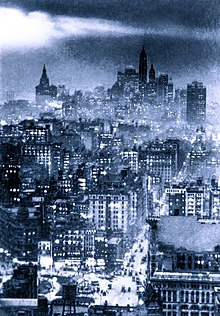
Rhapsody in Blue has been interpreted as a musical portrait of Jazz Age New York City.
Rhapsody in Blue has been interpreted every bit a musical portrait of early-20th-century New York City.[114] Civilization scribe Darryn King wrote in The Wall Street Journal that "Gershwin'south fusion of jazz and classical traditions captures the thriving melting pot of Jazz Age New York."[114]
Likewise, music historian Vince Giordano has opined that "the syncopation, the blue notes, the ragtime and jazz rhythms that Gershwin wrote in 1924 was actually a feeling of New York Urban center in that astonishing era. The rhythm of the city seems to be in there."[114] Pianist Lang Lang echoes this sentiment: "When I hear Rhapsody in Blue, I come across the Empire State Building somehow. I see the New York Skyline in midtown Manhattan, and I already see the coffee shops [in] Times Square."[114]
Accordingly, the opening montage of Woody Allen's 1979 film Manhattan features a rendition by Zubin Mehta in which quintessential New York scenes are set up to the music of Gershwin's famed jazz concerto.[115] Twenty years later, Walt Disney Pictures used the composition for the New York segment of the 1999 blithe picture show Fantasia 2000, in which the piece lyrically frames an animated segment drawn in the fashion of illustrator Al Hirschfeld.[116]
Influence on composers [edit]
Gershwin's rhapsody has influenced a number of composers. In 1955, Rhapsody in Blue served equally the inspiration for a composition past accordionist and composer John Serry Sr. which was subsequently published in 1957 equally American Rhapsody.[117] Brian Wilson, leader of The Beach Boys, stated on several occasions that Rhapsody in Bluish is one of his favorite pieces. He first heard the slice when he was ii years old and recalled that he adored it.[118] According to biographer Peter Ames Carlin, it was an influence on his Smile album.[118] Rhapsody in Bluish besides inspired a collaboration betwixt blind savant British pianist Derek Paravicini and composer Matthew King on a new concerto, called Blue premiered at the South Bank Middle in London in 2011.[119]
Other use [edit]
Rhapsody in Blue was played simultaneously by 84 pianists at the opening ceremony of the 1984 Summer Olympics in Los Angeles.[64] [120] Pianists Herbie Hancock and Lang Lang performed Rhapsody in Blueish at the 50th Grammy Awards on February 10, 2008.[121] Since 1980, the piece has been used by United Airlines in their advertisements, in pre-flight rubber videos, and in the Terminal 1 hole-and-corner walkway at Chicago O'Hare International Airport.[122] [123]
Preservation condition [edit]
On September 22, 2013, it was announced that a musicological critical edition of the full orchestral score will be somewhen released. The Gershwin family unit, working in conjunction with the Library of Congress and the University of Michigan, are working to make these scores available to the public.[124] [125] Though the unabridged Gershwin project may take 40 years to complete, the Rhapsody in Blue edition volition be an early book.[126] [127]
Rhapsody in Blue entered the public domain on Jan i, 2020, although private recordings of it may remain nether copyright.[128] [129]
References [edit]
Notes [edit]
- ^ Bandleader Paul Whiteman gave abroad many complimentary tickets to promote the concert and, consequently, lost money.[42] He expended $11,000, and the concert only netted $4,000.[42]
- ^ The omissions include the confined from rehearsal mark 14 to halfway through the fifth bar of rh. 18; from two bars before rh. 22 to the quaternary bar of rh. 24; and the start four bars of rh. 38.
- ^ The June 10, 1924, acoustic recording was labeled Victor 55225.[71] It purportedly featured the original clarinetist, Ross Gorman, performing the opening glissando.[71]
- ^ The April 21, 1927, electrical recording was labeled Victor 35822.[74] Nathaniel Shilkret conducted the orchestra.[74] This version was dubbed onto an RCA Victor 33+ 1⁄iii -rpm in 1932.
- ^ Twenty-five years later, Fiedler and the Boston Pops made another pop recording of the work in stereophonic sound with Earl Wild at the piano for RCA Victor in 1959.
Citations [edit]
- ^ 1924 Copyright Filing.
- ^ a b c Schiff 1997, p. 53.
- ^ a b c Cowen 1998.
- ^ a b c d e f Downes 1924, p. 16.
- ^ a b Ciment 2015, p. 265.
- ^ Gilbert 1995, p. 71.
- ^ a b c Howard 2003.
- ^ a b c d Goldberg 1958, p. 154.
- ^ Schiff 1997, Book jacket.
- ^ a b Schwarz 1999.
- ^ Greenberg 1998, p. 61.
- ^ Forest 1996, pp. 68–69, 112.
- ^ Wood 1996, p. 112; Howard 2003.
- ^ Wood 1996, p. 81.
- ^ a b c Schwartz 1979, p. 76.
- ^ Woods 1996, p. 81; Jablonski 1999.
- ^ Schiff 1997, p. 53; Schwartz 1979, p. 76.
- ^ Schwartz 1979, p. 76; Wood 1996, p. 81.
- ^ Jablonski 1999.
- ^ a b c Greenberg 1998, pp. 64–65.
- ^ a b Goldberg 1958, p. 139.
- ^ a b c d e f Schiff 1997, p. 13.
- ^ Reef 2000, p. 38.
- ^ a b Greenberg 1998, p. 69.
- ^ a b c Goldberg 1958, p. 143.
- ^ Goldberg 1958, p. 142.
- ^ a b c Jenkins 1974, p. 144.
- ^ a b c Wood 1996, p. 85; Jenkins 1974, p. 144.
- ^ a b Wood 1996, p. 85.
- ^ Schwartz 1979, p. 84.
- ^ Goldberg 1958, p. 144.
- ^ Goldberg 1958, p. 145.
- ^ Goldberg 1958, pp. 146–147.
- ^ Schiff 1997, pp. 55–61.
- ^ a b Greenberg 1998, pp. 72.
- ^ Greenberg 1998, pp. 72–73.
- ^ Schwartz 1979, pp. 81–83.
- ^ Goldberg 1958, p. 147.
- ^ a b c Schwartz 1979, p. 89.
- ^ Schwartz 1979, pp. 88–89.
- ^ a b Goldberg 1958, p. 152.
- ^ a b Goldberg 1958, pp. 142, 148.
- ^ a b c Goldberg 1958, p. 148.
- ^ a b Radio Times 1925.
- ^ Royal Albert Hall 1926.
- ^ Rust 1975, p. 1929.
- ^ Rayno 2013, p. 203.
- ^ a b Jablonski 1992, p. xxx.
- ^ a b Schneider 1999, p. 180.
- ^ Slonimsky 2000, p. 105.
- ^ Greenberg 1998, pp. 74–75.
- ^ a b Schneider 1999, p. 182.
- ^ a b c Wyatt & Johnson 2004, p. 297.
- ^ a b Schiff 1997, p. 4.
- ^ Greenberg 1998, p. 66.
- ^ a b Goldberg 1958, p. 153.
- ^ Bañagale 2014, pp. 45–46.
- ^ Bañagale 2014, p. iv.
- ^ a b c Schiff 1997, p. 5.
- ^ Sultanof 1987.
- ^ a b Levy 2019.
- ^ Schiff 1997, p. 5; Goldberg 1958, p. 148; Sultanof 1987; Levy 2019.
- ^ a b c Greenberg 1998, p. 76.
- ^ a b Bañagale 2014, p. 43.
- ^ Bañagale 2014, p. 44.
- ^ Greenberg 1998, p. 67.
- ^ a b Schiff 1997, p. 65.
- ^ Ferencz 2011, p. 143.
- ^ Ferencz 2011, p. 141.
- ^ Greenberg 1998, pp. 75; Schiff 1997.
- ^ a b Rust 1975, p. 1924.
- ^ Rust 1975, p. 1924; Rayno 2013, p. 327.
- ^ Schiff 1997, p. 64.
- ^ a b c Rust 1975, p. 1931.
- ^ Greenberg 1998, pp. 75–76; Rust 1975, p. 1931.
- ^ Sobczynski 2018; Greenberg 1998, p. 78.
- ^ The New York Times 1932: "Despite the depression, the Boston 'Pops' have been astonishingly successful this season, sold-out houses being an nearly nightly circumstance."
- ^ Moore 1935, p. 7; Sherman 1935.
- ^ Moore 1935, p. vii: "This piece, introduced a decade agone by Paul Whiteman, rapidly grew and so pop that another version had to be fabricated, changing from the Whiteman instrumentation to that of the conventional symphony orchestra, which is the instance here."
- ^ Sherman 1935.
- ^ Billboard 1945, p. 24.
- ^ Tampa Bay Times 1945, p. 35: "Levant was a close friend of Gershwin and was a wise pick to do the thrilling new recording of the Rhapsody. Levant's interpretation is fiery and brilliant."
- ^ Greenberg 1998, pp. 49, 212.
- ^ Cassidy 1945, p. 11: "Oscar Levant ghosts Gershwin'southward playing, and he comes closer than anyone else to recapturing what sometimes seems to accept been a ane man idiom."
- ^ Tampa Bay Times 1945, p. 35; Billboard 1945, p. 24.
- ^ Palmer 1973.
- ^ Palmer 1973: "Rhapsody resembles the Gershwin original just when strings and horns interrupt extended guitar and keyboard solos with fragments of the work's master themes. The solos are played over upward‐tempo neo‐samba rhythms.... these long improvisational sections have lilliputian to practice with the thematic material which is inserted here and at that place".
- ^ Billboard 1973, pp. 27, 56.
- ^ Mazey 1985: "Clayderman butchered Gershwin's intoxicating Rhapsody in Blue, for instance, with a pulsing disco beat. If they always do a tape called Hooked on Gershwin, Clayderman is their man."
- ^ Colford 1985.
- ^ Smith 1973, p. 10.
- ^ Schiff 1997, pp. 67–68.
- ^ Westphal 2006.
- ^ Schiff 1997, p. 26.
- ^ Goldberg 1958, p. 157.
- ^ a b Greenberg 1998, p. 70.
- ^ a b Chen & Smith 2008.
- ^ a b Gilbert 1995, p. 17.
- ^ Bañagale 2014, pp. 39–42.
- ^ a b c Bañagale 2014, p. 107.
- ^ a b c Schiff 1997, p. fourteen.
- ^ a b Gilbert 1995, p. 68.
- ^ a b Schiff 1997, p. 28.
- ^ Schiff 1997, p. 29.
- ^ Schiff 1997, p. 12.
- ^ Schneider 1999, p. 187.
- ^ Schiff 1997, p. 36.
- ^ Sisk 2016.
- ^ Levin 2002, p. 73.
- ^ Fitzgerald 2004, p. 93.
- ^ a b Teachout 1992.
- ^ Mizener 1960.
- ^ Bañagale 2014, pp. 156–157.
- ^ a b c d Male monarch 2016.
- ^ King 2016; Cooper 2016.
- ^ Solomon 1999.
- ^ Serry 1957.
- ^ a b Carlin 2006, pp. 25, 118.
- ^ BBC News 2011.
- ^ Schiff 1997, p. 1.
- ^ Swed 2009.
- ^ United Airlines 2020; Bañagale 2014, pp. 158–173.
- ^ Eldred v. Ashcroft 2003.
- ^ Gershwin Initiative 2013.
- ^ Canty 2013.
- ^ Clague & Getman 2015.
- ^ Clague 2013.
- ^ King & Jenkins 2019.
- ^ Jenkins 2019.
Works cited [edit]
Impress sources [edit]
- "A Concert of Syncopated Symphonic Music". Radio Times. No. xc. London, England. June 12, 1925. p. 538. Retrieved June 17, 2020.
- Bañagale, Ryan Raul (2014). Arranging Gershwin: Rhapsody in Blue and the Creation of an American Icon. Oxford, England: Oxford University Press. doi:10.1093/acprof:oso/9780199978373.001.0001. ISBN978-0-19-997837-three.
- "Acknowledged Record Albums by Classical Artists (1945)". The Billboard. Vol. 57, no. 35. September 1, 1945. p. 24. Retrieved November 10, 2020.
- "Billboard Top 50 Easy Listening (1973)". The Billboard. Vol. 85, no. 38. September 22, 1973. pp. 27, 56. Retrieved February 21, 2022.
- "Boston's 'Pop' Concerts". The New York Times. New York City. June 22, 1932. p. 4X. Retrieved February 21, 2022.
- Carlin, Peter Ames (2006). Catch a Wave: The Ascent, Fall and Redemption of the Beach Boys' Brian Wilson. London: Rodale. ISBN978-ane-59486-899-3.
- Ciment, James (2015) [2008]. Encyclopedia of the Jazz Age: From the End of Earth War I to the Swell Crash. Taylor & Francis. ISBN978-1-317-47165-3 . Retrieved October twenty, 2020.
- Colford, Paul D. (October nine, 1985). "He's Almost World Famous: Meet Richard Clayderman, 'the globe'due south most popular pianist'". Newsday. Melville, New York. p. 131. Retrieved February 21, 2022 – via Newspapers.com.
- "Columbia, Victor Dedicates Albums to Gershwin". Tampa Bay Times. Leningrad, Florida. July 29, 1945. p. 35. Retrieved February 21, 2022 – via Newspapers.com.
- Eldred 5. Ashcroft , 01 U.S. 618, p. 67 (United States Supreme Court January 15, 2003) ("Even the $500,000 that United Airlines has had to pay for the right to play George Gershwin's 1924 classic Rhapsody in Blue represents a price of doing business, potentially reflected in the ticket prices of those who fly.").
- Ferencz, George J. (2011). "Porgy and Bess on the Concert Stage: Gershwin's 1936 Suite (Catfish Row) and the 1942 Gershwin–Bennett Symphonic Picture". The Musical Quarterly. 94 (1–ii): 93–155. doi:10.1093/musqtl/gdq019. ISSN 1741-8399. JSTOR 41289202.
Reissuance of The Rhapsody in Blue re-scored by yourself for big symphony orchestra
- Fitzgerald, F. Scott (2004). Conversations with F. Scott Fitzgerald. Jackson, Mississippi: University Printing of Mississippi. ISBN978-1-57806-605-six.
- Gilbert, Steven Eastward. (1995). The Music of Gershwin. New Haven, Connecticut: Yale Academy Press. ISBN978-0-300-06233-5.
- Goldberg, Isaac (1958) [1931]. George Gershwin: A Study in American Music. New York: Frederick Ungar Publishing Company. LCCN 58-11627 – via Internet Archive.
- Greenberg, Rodney (1998). George Gershwin . London: Phaidon Printing. ISBN978-0-7148-3504-4.
- Jablonski, Edward (1992). Gershwin Remembered. Portland, Oregon: Amadeus Press. ISBN0-931340-43-eight.
- Jenkins, Alan (1974). The Twenties. U.k.: Peerage Books. ISBN978-0-434-90894-3 . Retrieved Baronial 1, 2020.
- Levin, Floyd (April xxx, 2002). Classic Jazz: A Personal View of the Music and the Musicians. ISBN978-0-520-23463-5 . Retrieved November 10, 2020.
- Mazey, Steve (September 19, 1985). "'Elevator' pianist banal, lacks vitality, passion". The Ottawa Citizen. Ottawa, Ontario. Retrieved February 21, 2022 – via Newspapers.com.
- Mizener, Arthur (April 24, 1960). "Gatsby, 35 Years Later". The New York Times. New York. Retrieved June four, 2021.
- Moore, Edward (October 6, 1935). "New Musical Records Skim Many Moods". The Chicago Tribune. Chicago, Illinois. p. vii. Retrieved February 21, 2022 – via Newspapers.com.
- Palmer, Robert (August 26, 1973). "Recordings: Popular/Jazz Meets Classical Rock". The New York Times. New York City. p. 22D. Retrieved Feb 21, 2022.
- Rayno, Don (2013). Paul Whiteman: Pioneer in American Music, Book 2: 1930–1967. Scarecrow Press. ISBN978-0-8108-8204-1.
- Reef, Catherine (2000). George Gershwin: American Composer. Greensboro, North Carolina: Morgan Reynolds Publishing. ISBN978-one-883846-58-9.
- Rust, Brian (1975). The American Dance band Discography 1917–1942. Vol. ii. New Rochelle, New York: Arlington House. ISBN0-87000-248-1.
- Schiff, David (1997). Gershwin: Rhapsody in Blue. Cambridge, England: Cambridge University Press. doi:10.1017/CBO9780511620201. ISBN978-0-521-55077-ii.
- Schneider, Wayne, ed. (1999). The Gershwin Fashion: New Looks at the Music of George Gershwin. Oxford, England: Oxford University Press. ISBN978-0-19-509020-eight.
- Schwartz, Charles (1979). Gershwin: His Life and Music . New York: Da Capo Printing. ISBN978-0-306-80096-2 – via Internet Archive.
- Serry, John (1957). American Rhapsody, Copyright: Alpha Music Co (Study). Washington, D.C.: Library of Congress Copyright Role.
- Sherman, John Yard. (October 26, 1935). "Gershwin Rhapsody Vividly Interpreted". The Minneapolis Star. Minneapolis, Minnesota. p. 34 – via Newspapers.com.
- Slonimsky, Nicolas (2000) [1953]. Lexicon of Musical Invective: Disquisitional Assaults on Composers Since Beethoven's Fourth dimension. New York: W. W. Norton & Company. ISBN978-0-393-32009-1.
- Smith, Wayne A. (January 27, 1973). "Around the Clock: Rhapsody Revived". The Greenfield Recorder. Greenfield, Massachusetts. p. 10.
- Sultanof, Jeff, ed. (1987). Rhapsody in Bluish: Commemorative Facsimile Edition. Secaucus, New Jersey: Warner Brothers Music.
This reproduces Grofé's holograph manuscript from the Gershwin Collection, Music Sectionalization, Library of Congress.
- Wood, Ean (1996). George Gershwin: His Life and Music. London: Sanctuary Publishing. ISBN978-one-86074-174-6.
- Wyatt, Robert; Johnson, John Andrew, eds. (2004). "Leonard Bernstein: "Why Don't You Run Upstairs and Write a Nice Gershwin Tune?" (1955)". The George Gershwin Reader: Readers on American Musicians. Oxford, England: Oxford University Press. ISBN978-0-19-802985-four.
Online sources [edit]
- "Blind Autistic Homo Stuns the Music World". BBC News. London, England. September 28, 2011. Retrieved January 24, 2019.
- Cassidy, Claudia (July 31, 1945). "On the Tape: Levant's 'Rhapsody in Blue' All-time of Electric current Crop of Gershwin Record Albums". The Chicago Tribune. p. eleven. Retrieved Feb 21, 2022 – via Newspapers.com.
- Canty, Cynthia (October 21, 2013). "The Academy of Michigan Was Selected for the 'Gershwin Initiative'". Ann Arbor, Michigan: Michigan Radio. Retrieved August 30, 2015.
- Clague, Mark (September 21, 2013). "George and Ira Gershwin Disquisitional Edition". Musicology At present. New York City: American Musicological Society. Retrieved May 31, 2021.
- Clague, Mark; Getman, Jessica (2015). "The Editions". The Gershwin Initiative. Ann Arbor, Michigan: Academy of Michigan. Archived from the original on September v, 2015. Retrieved August 30, 2015.
- Chen, Jer Ming; Smith, John (2008). "How to Play the First Bar of Rhapsody in Blue". Acoustical Gild of America. Archived from the original on April 25, 2013. Retrieved April 28, 2013.
- Cooper, Michael (September fifteen, 2016). "The Philharmonic Accompanies 'Manhattan,' Just as It Did in 1979". The New York Times . Retrieved November seven, 2020.
- Cowen, Ron (1998). "George Gershwin: He Got Rhythm". The Washington Post . Retrieved August thirty, 2015.
- Downes, Olin (Feb 13, 1924). "A Concert of Jazz". The New York Times. p. 16. Retrieved June 28, 2020.
- Howard, Orrin (2003). "Rhapsody in Blue". Los Angeles: Los Angeles Philharmonic Association. Archived from the original on February 23, 2005. Retrieved January 24, 2019.
- Jablonski, Edward (1999). "Glorious George". Cigar Aficionado. Archived from the original on January 17, 2006. Retrieved January 24, 2019.
- Jenkins, Jennifer (December 30, 2019). "Public Domain Day 2020". Duke Law Schoolhouse's Center for the Report of the Public Domain. Archived from the original on December xxx, 2019. Retrieved January 1, 2020.
- King, Darryn (September 15, 2016). "How 'Rhapsody in Blue' Perfectly Channels New York". The Wall Street Journal. New York City. Retrieved November 9, 2020.
- King, Noel; Jenkins, Jennifer (Dec 30, 2019). "1924 Copyrighted Works To Become Part Of The Public Domain". NPR. Archived from the original on Jan 4, 2020. Retrieved Jan 1, 2020.
- Levy, Aidan (2019). "'Rhapsody In Blue' at ninety". JazzTimes. Braintree, Massachusetts.
Like a train, Gershwin'south sprawling limerick had more than moving parts than Whiteman had musicians, even augmented with strings, but the band was and then versatile that three reed players managed to play a total of 17 parts, including the oboe-like heckelphone, switching as the music dictated.
- Library of Congress - Copyright Office (1924). Itemize of Copyright Entries - Part 3: Musical Compositions . Vol. 19. The states Copyright Role. U.S. Govt. Print. Off.
- Paul Whiteman and His Orchestra (1926). Paul Whiteman Orchestra — Live at the Imperial Albert Hall in 1926 (HMV Recording). Majestic Albert Hall. Archived from the original on December 11, 2021. Retrieved June 17, 2020.
- "Rhapsody Remastered". United Airlines. 2020. Retrieved April 27, 2020.
- Schwarz, Frederick D. (1999). "Time Motorcar: Seventy-v Years Ago Gershwin's Rhapsody". American Heritage. Vol. 50, no. 1. Archived from the original on May 7, 2006. Retrieved February 17, 2007.
- Sisk, Sarah (February 12, 2016). "When Bluish Was New: Rhapsody in Blue's Premiere at 'An Experiment in Modern Music'". The Gershwin Initiative. Academy of Michigan Schoolhouse of Music, Theatre & Dance. Retrieved November ten, 2020.
- Sobczynski, Peter (Apr 9, 2018). "Criterion Returns King of Jazz to Its Rightful Throne". RogerEbert.com . Retrieved November ten, 2020.
- Solomon, Charles (1999). "Rhapsody in Bluish: Fantasia 2000'south Jewel in the Crown". Animation Globe Magazine. Vol. 4, no. ix. Archived from the original on October 13, 2007. Retrieved January 24, 2019.
- Swed, Marker (August 8, 2009). "Music Review: Lang Lang and Herbie Hancock at the Hollywood Bowl". Culture Monster. Los Angeles Times. El Segundo, California. Retrieved January 24, 2019.
- Teachout, Terry (Jan 19, 1992). "The Fabulous Gershwin Boys". The Washington Post . Retrieved November 7, 2020.
- "The Gershwin Initiative". Academy of Michigan School of Music, Theatre & Trip the light fantastic toe. 2013. Retrieved Baronial xxx, 2015.
- Westphal, Matthew (November 3, 2006). "Michel Camilo and Barcelona Symphony Win Classical Latin Grammy for Rhapsody in Blueish". Playbill . Retrieved November 10, 2020.
External links [edit]
- Rhapsody in Blueish: Scores at the International Music Score Library Project
- Rhapsody in Bluish: Yuja Wang Functioning 2016 (video; sixteen:01) on YouTube
- Gershwin's Original Manuscript for Rhapsody in Blue at the Library of Congress
Source: https://en.wikipedia.org/wiki/Rhapsody_in_Blue
0 Response to "what famous gershwin work has by some, been upgraded to the status of opera, rather than musical?"
Postar um comentário